 Gitcoin
 coordinates public goods funding through grants, community decisions, and research
Gitcoin coordinates grants and public goods funding, connecting community priorities with financial support for open-source projects. Its funding ecosystem combines donor participation, allocation mechanisms, and research. Quadratic funding, private voting, and impact assessment inform different funding decisions, with eligibility and participation rules set by individual rounds.
A funding mechanism determines how support is allocated, while each grant round sets its own participation rules.
Gitcoin Grants, allocation tools, and research have distinct roles
Gitcoin Grants
The grants program organizes funding for shared resources, including open-source software and Ethereum infrastructure. Projects seek support within a campaign's theme, while donors and matching-fund contributors supply capital. Public goods can benefit people beyond their financial supporters, making collective funding relevant to resources a community uses together.
Allo Protocol and Grants Stack
Allo Protocol supplied programmable smart contracts for funding pools and allocation strategies. Grants Stack was the application suite built on that infrastructure. This separated capital distribution rules from the interfaces used to operate rounds; the two names describe different layers of the former technology stack.
The funding directory and research library
The directory organizes funding applications, campaigns, research, mechanisms, and case studies across the wider Ethereum ecosystem. Research topics include identity infrastructure, retroactive funding, and capital allocation. These activities explain funding approaches and their outcomes.
Domain allocators connect community priorities with round design
Gitcoin 3.0 organized the 2025 Gitcoin Grants 24 (GG24) campaign around domains, each with allocators designing suitable rounds. Community sensemaking identified priorities before holders of the GTC governance token voted on domains. Allocators then selected mechanisms, recruited funding partners, and assessed outcomes.
GG24's six domains covered:
- Ethereum developer tooling and infrastructure
- Privacy
- Interoperability standards, infrastructure, and analytics
- Public goods research and development
- Targeted development and adoption
- InfoFi, or information finance
A domain's budget and a particular round's matching pool refer to different scopes. Several mechanisms could share one domain, and partner co-funding could complement capital from Gitcoin.
How does quadratic funding distribute a matching pool?
Quadratic funding (QF) distributes sponsor-backed matching capital using the pattern of individual donations, so broad participation can influence allocation alongside contribution amounts. Direct donations supply money to a project; matching funds come from a separate committed pool. Allocation also reflects the round's rules and safeguards against coordinated manipulation. This gives a funding program a signal about community support, especially when projects attract many distinct contributors. A visible donation total alone cannot establish a project's final match.
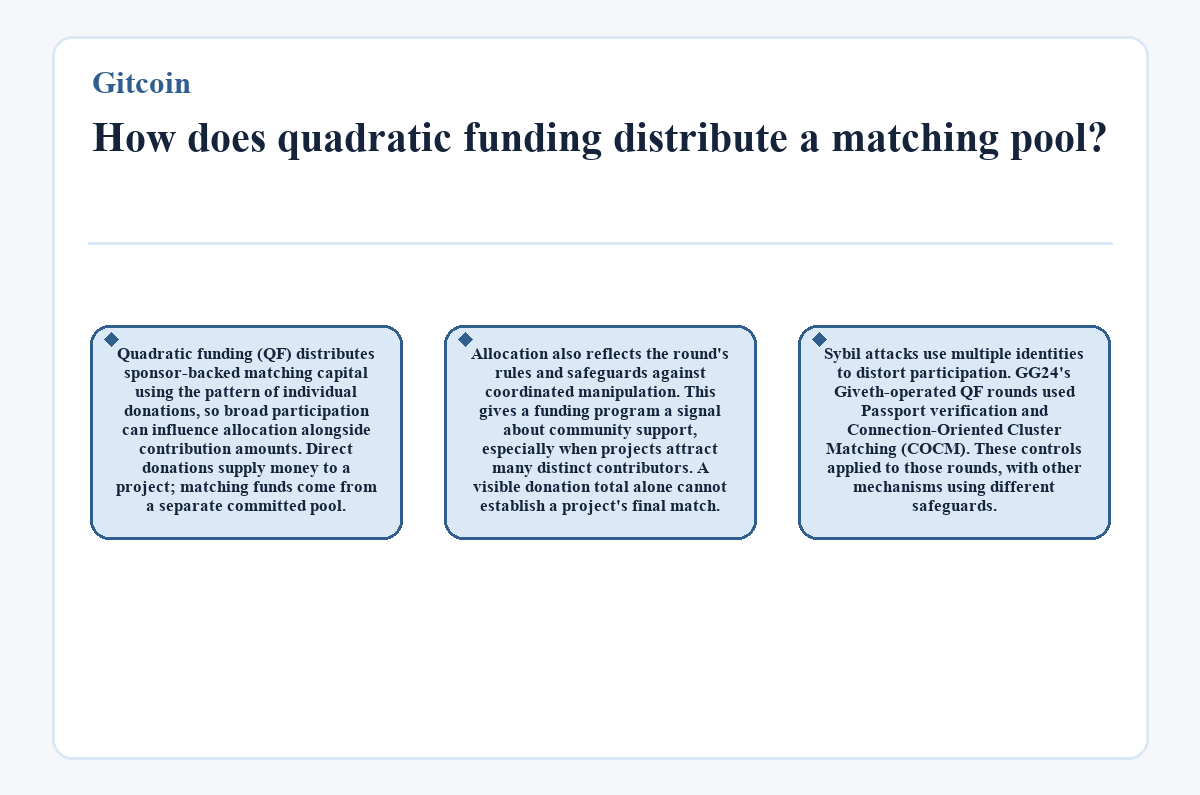
Sybil attacks use multiple identities to distort participation. GG24's Giveth-operated QF rounds used Passport verification and Connection-Oriented Cluster Matching (COCM). These controls applied to those rounds, with other mechanisms using different safeguards.
Private voting and impact assessment answer different funding questions
MACI and private votes
MACI supported private voting designed to reduce collusion in GG24's Privacy round, which ran through Privote. Vote privacy concerned how participants expressed preferences. The round separately evaluated project eligibility across its defined categories.
Deep Funding and repository assessment
Deep Funding used prediction-market-supported evaluations of code repositories, while the domain's separate QF round used community donations to inform matching. These mechanisms brought repository assessment and public participation into the same developer-tooling domain.
Conviction voting, retroactive funding, and Hypercerts
The public goods research and development domain paired conviction voting through Gardens with retroactive funding through Karma. It included proactive development support and later impact evaluation. Targeted development and adoption also combined these approaches, alongside Trust Graph, with its own projects and funding decisions. GG24's broader mix also included peer-reviewed Hypercerts, or impact certificates.
Gitcoin retired Grants Stack while the grants program continued
Gitcoin retired Grants Stack in May 2025. The grants program continued through partner platforms. Older instructions for that application suite therefore described a different operating setup from GG24.
Allo's contracts remained deployed and open source after active development ceased. Their continued existence did not establish a maintained hosted interface. GG24 used Giveth for its developer-tooling and interoperability QF rounds, while Privote, Gardens, and Karma supported other mechanisms. Domain operators could choose infrastructure suited to their funding approaches, so program continuity did not imply continuity of every application or participation flow.
Do all projects face the same grant requirements?
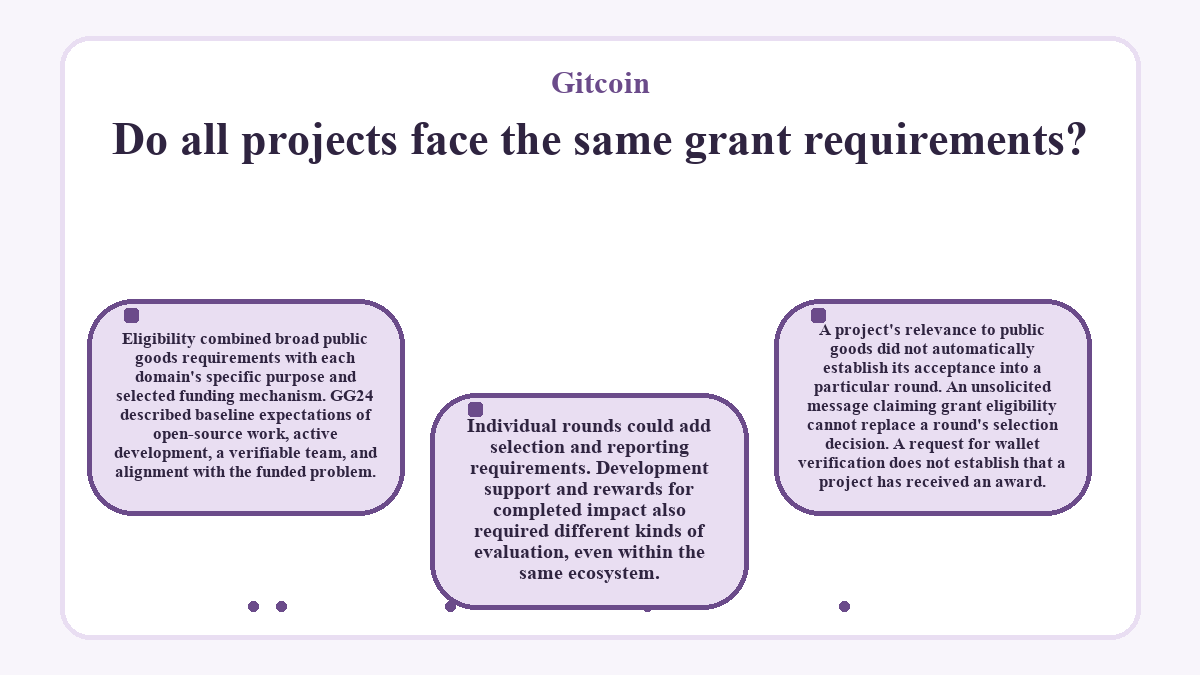
Eligibility combined broad public goods requirements with each domain's specific purpose and selected funding mechanism. GG24 described baseline expectations of open-source work, active development, a verifiable team, and alignment with the funded problem. Individual rounds could add selection and reporting requirements. Development support and rewards for completed impact also required different kinds of evaluation, even within the same ecosystem. A project's relevance to public goods did not automatically establish its acceptance into a particular round.
An unsolicited message claiming grant eligibility cannot replace a round's selection decision. A request for wallet verification does not establish that a project has received an award.
Giveth rounds shared a mechanism while using different networks
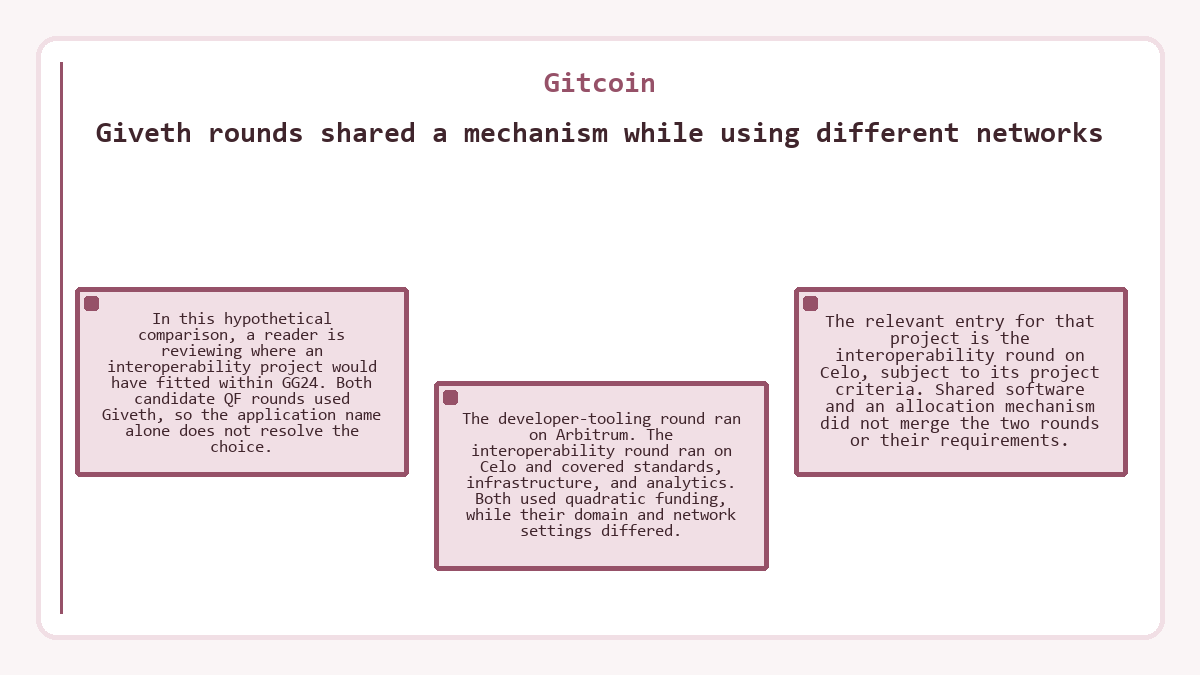
In this hypothetical comparison, a reader is reviewing where an interoperability project would have fitted within GG24. Both candidate QF rounds used Giveth, so the application name alone does not resolve the choice.
The developer-tooling round ran on Arbitrum. The interoperability round ran on Celo and covered standards, infrastructure, and analytics. Both used quadratic funding, while their domain and network settings differed.
The relevant entry for that project is the interoperability round on Celo, subject to its project criteria. Shared software and an allocation mechanism did not merge the two rounds or their requirements.
The Octant pilot links treasury yield with grant matching
On May 7, 2026, Gitcoin announced implementation of an Octant v2 vault pilot to finance matching from realized yield. The announcement described treasury USDC deployed into Morpho's Steakhouse USDC strategy.
Octant supplied vault and routing infrastructure, while Gitcoin governance retained allocation authority. The vault framework used ERC-4626 accounting and Yearn v3 architecture. The design routed realized yield to matching instead of compounding it for depositors.
Principal preservation was a design objective; strategy losses and smart contract failures could still reduce deposited capital. Available matching funds would depend on realized yield. Continuation, scaling, and reuse of accumulated yield beyond the pilot required evaluation and separate governance discussion and approval.
The initial arrangement described in that announcement paired $1,000,000 from Gitcoin with $1,000,000 from Octant. The partners used separate vaults with the same yield destination, for combined deployed capital of $2,000,000.
Gitcoin FAQ
When did Gitcoin begin supporting open-source work?
Gitcoin began in 2017 with a focus on open-source development and software bounties. The grants program launched in 2019 and became associated with quadratic funding for public goods. Its early bounty work supported specific development tasks, while later grant rounds connected project funding with community contributions and matching pools.
Can education or research projects qualify for funding?
Education and research projects have qualified within rounds whose themes and criteria included that work. GG24's Privacy round accepted projects in dApps, infrastructure, education, and research. That historical scope shows funding extended beyond software repositories. Each campaign set its own criteria, so an educational format alone did not establish eligibility.
How long was the GG24 quadratic funding donation window?
The Giveth-hosted GG24 QF donation window ran from October 14 to October 28, 2025. Deep Funding, conviction voting, and retroactive evaluation followed domain-specific schedules, with some work continuing into 2026. Those dates describe GG24 and do not provide an application or donation deadline for a later campaign.
Is every funding platform in the directory operated by Gitcoin?
The directory includes funding programs run by other organizations. Ethereum Foundation ESP is the Foundation's direct grants program, while Protocol Guild supports Ethereum core protocol contributors through a separate collective funding mechanism. Participation requirements remain specific to the program and its operator.
What did GG24's approximately $1.8 million funding figure include?
That figure described funding available across six domains, combining Gitcoin allocations and external partner co-funding. The announced aggregate was $1,807,500: $1,175,000 from Gitcoin and $632,500 from partners. It covered multiple mechanisms and was broader than the $300,000 assigned to the two Giveth QF matching pools. It did not describe one project's award or one uniform payout schedule.
Can I contribute without donating or applying for a grant?
Content contributions are another participation path. The funding directory invites submissions of applications, mechanisms, case studies, and research, along with edits to existing entries. A submission must meet the directory's contribution guidelines. Contributing an entry supports understanding of funding approaches and is separate from applying for grant funding.
Does an approved GG24 grant mean the full award has been paid?
Approval records a funding decision, while full disbursement means the entire award has been paid. GG24's Solutions Development program used milestone-based grants and reported 19 approved projects. The approval count did not establish how much funding each project had received or whether it met conditions for later payments.