 Gitcoin
 quadratic funding allocates a matching pool using donor contributions and round rules
Gitcoin quadratic funding (QF) uses eligible contributions and round rules to allocate a matching pool. The square-root formula measures support before pool limits and review shape the final award. A useful estimate keeps direct donations separate from additional matching and uses the contribution data the round accepts. Donor eligibility, cluster adjustments, and project caps can affect the amount eventually allocated. A displayed projection remains distinct from both an approved award and a completed distribution.
In short: A campaign budget may cover several mechanisms, so a QF estimate must use the budget assigned to its matching pool.
Establish the matching round behind the estimate
An estimate needs inputs from the same funding pool, participating project, and contribution window. A campaign's headline budget may cover several pools or allocation mechanisms. The budget available for project matching must exclude any funds reserved for round operations.
Contribution data
Project admission establishes participation in a round; donor eligibility determines which contributions influence matching. A project's entire fundraising history therefore need not equal its qualifying contribution total. Amounts also need a common valuation unit. Adding unconverted quantities of different tokens cannot produce a meaningful estimate, even when every transfer supports the same project. Giveth-operated QF also requires an eligible network, an active round, and the specified minimum contribution. Donors must complete the required verification before the round ends.
Allocation and payment
A settled donation establishes direct support. A finalized allocation assigns additional support from the matching pool. Payment evidence must establish the matching distribution separately. These distinctions matter when comparing an estimate with money a project has received: the contribution record alone does not establish the additional award. Giveth's displayed estimates do not yet account for donor eligibility or post-round disqualifications. Those exclusions explain why a visible donation can affect a projection without qualifying for finalized matching.
What does the square-root formula calculate?
In the basic QF model, the square of the sum of square roots gives total modeled funding, including direct contributions. That funding level and the additional subsidy are different quantities.
Let c i denote each donor's eligible contribution total for this project and round, expressed in a common unit. Modeled funding is F = (Σ√ c i ) 2 , while eligible direct donations total D = Σ c i . The unconstrained subsidy is R = F - D .
Subtracting direct donations isolates the extra funding the basic model requires. It prevents the donors' own contributions from being counted again as sponsor matching. The subsidy still needs a budget constraint.
A round's implementation determines which weights enter its allocation. Normalizing the full squared signal and normalizing the subsidy are different conventions. Reproducing a published estimate requires the same convention, together with the round's adjustments. The basic formula explains the relationship; it does not specify every operator's final algorithm.
Can one project's donations determine its final match?
A project's donations cannot determine its final share when other eligible projects compete for the same matching budget. Its weight supplies one part of a calculation involving the whole pool. Published pool size alone cannot fill in missing allocation weights for competing projects.
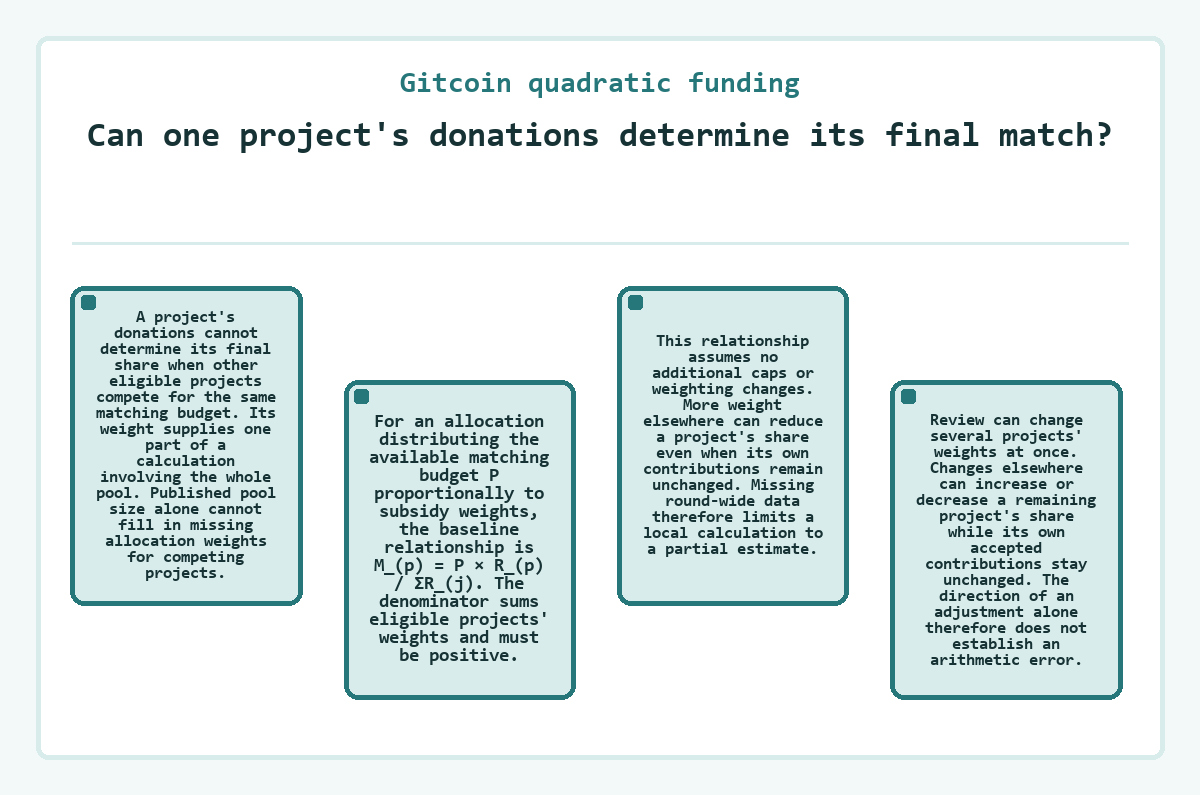
For an allocation distributing the available matching budget P proportionally to subsidy weights, the baseline relationship is M p = P × R p / Σ R j . The denominator sums eligible projects' weights and must be positive. This relationship assumes no additional caps or weighting changes. More weight elsewhere can reduce a project's share even when its own contributions remain unchanged. Missing round-wide data therefore limits a local calculation to a partial estimate.
Review can change several projects' weights at once. Changes elsewhere can increase or decrease a remaining project's share while its own accepted contributions stay unchanged. The direction of an adjustment alone therefore does not establish an arithmetic error.
Independent contributors and donor connections change the signal
The basic model treats each participant's contribution as an input, so identifying distinct contributors matters before applying square roots. A transaction count does not establish that distinction.
Repeated support from one donor
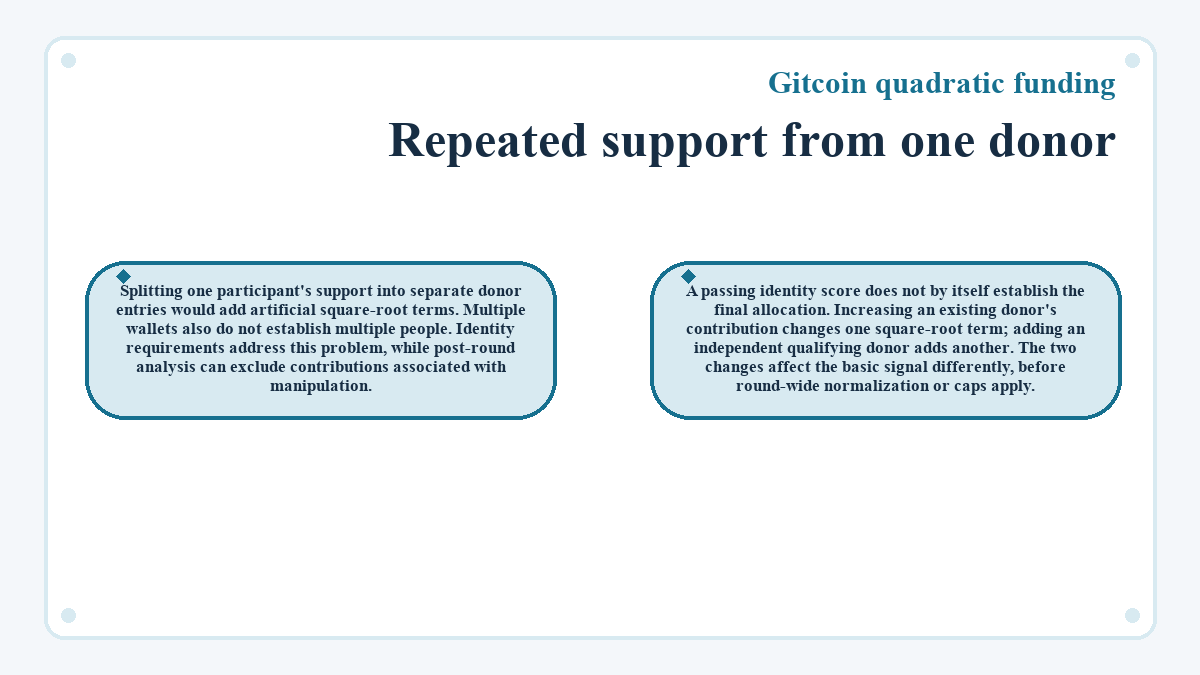
Splitting one participant's support into separate donor entries would add artificial square-root terms. Multiple wallets also do not establish multiple people. Identity requirements address this problem, while post-round analysis can exclude contributions associated with manipulation. A passing identity score does not by itself establish the final allocation. Increasing an existing donor's contribution changes one square-root term; adding an independent qualifying donor adds another. The two changes affect the basic signal differently, before round-wide normalization or caps apply.
Connected groups across projects
Connection-Oriented Cluster Matching (COCM) reduces matching influence from closely connected donor groups. It examines connections across the donation network, adding information a project's donor count omits. A basic calculator using only contribution amounts cannot reproduce those adjustments. Broad participation remains relevant, although the allocation also considers how independent that support appears under the selected method.
Project caps limit the matching allocation
A project cap limits additional matching within the round applying it. An estimate can rise toward that limit while subsequent donations continue adding direct support to the project.
GG24's Developer Tooling QF round on Arbitrum used a 10,000 USDC matching cap per project. That historical parameter does not establish a permanent Gitcoin-wide ceiling. Caps belong to their round configuration, and their application can interact with pool normalization. The final allocation must follow the operator's rules for both the ceiling and any remaining matching funds.
Historical calculators belong to their original round
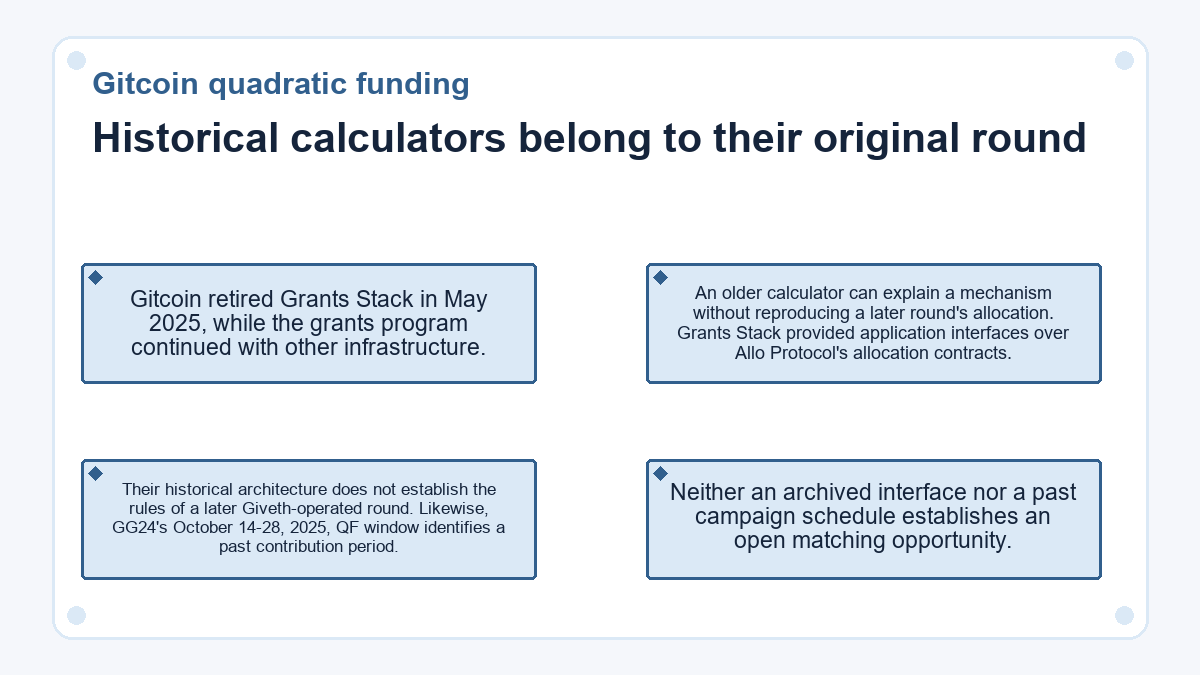
Gitcoin retired Grants Stack in May 2025, while the grants program continued with other infrastructure. An older calculator can explain a mechanism without reproducing a later round's allocation. Grants Stack provided application interfaces over Allo Protocol's allocation contracts. Their historical architecture does not establish the rules of a later Giveth-operated round. Likewise, GG24's October 14-28, 2025, QF window identifies a past contribution period. Neither an archived interface nor a past campaign schedule establishes an open matching opportunity.
Donation costs and matching impact use different inputs
For onchain contributions, donor expenditure includes the contribution and transaction fees. The matching input is the amount the round recognizes as the eligible donation, expressed in its valuation unit.
Execution fees do not become project donations merely because they form part of the same wallet expenditure. Their size depends on the network and transaction. A round's minimum qualifying donation is a separate rule. A settled contribution can fall below that minimum, leaving direct support without matching eligibility. Comparing donor expenditure with an estimated match therefore requires separating the recognized contribution from execution costs.
Which GG24 allocations used quadratic funding?
GG24 used QF with COCM for its Giveth-operated Developer Tooling and Interop rounds. The Privacy round also used QF, with MACI private voting through Privote. The campaign also included mechanisms such as Deep Funding and conviction voting, so its combined budget was not one QF matching pool.
| GG24 option | Allocation basis | Relevant scope |
|---|---|---|
| Giveth Developer Tooling QF | Donations with COCM adjustments | Developer tooling; payouts on Arbitrum |
| Giveth Interop QF | Donations with COCM adjustments | Interoperability; payouts on Celo |
| Deep Funding | Prediction-market repository evaluations | Developer tooling repositories |
| Privote private voting | QF with MACI encrypted voting | Privacy projects |
| Gardens | Conviction voting | Public Goods R&D and Targeted Development |
| Karma | Retroactive evaluation | Public Goods R&D and Targeted Development |
| InfoFi-native funding | Explored conditional funding markets | Information Finance |
MACI names voting infrastructure; its use alone does not specify a public-donation matching calculation. Deep Funding assessed repositories through prediction markets. Applying one square-root calculator across these allocations would erase the rules governing their different inputs.
Project donations and matching-pool support have different destinations
A project-directed donation supplies that recipient's crowdfunded support and, when eligible, contributes to its matching weight. A contribution to the matching pool supplies capital the round allocates across eligible projects. These actions affect different inputs: one changes project contributions, while the other changes the shared budget. Direct support identifies a recipient; matching-pool support delegates distribution to the round's allocation mechanism.
Popular questions about Gitcoin quadratic funding
Can a project's average donation reconstruct its QF score?
An average donation and donor count generally cannot reconstruct a project's QF score. Square roots apply to individual eligible contributions before summation, so the distribution matters. Equal contribution amounts permit a shortcut, but using an average for unequal amounts changes the calculation and can overstate the basic funding signal.
Is a project's match per donor the amount each new donor adds?
Match per donor is an average, while a new donation changes the allocation inputs. Dividing matching by donor count does not measure that donation's incremental effect. The added contribution changes the project's weight, potentially the pool-wide denominator, and possibly its interaction with a cap or cluster adjustment.
Does a donor's GTC balance increase the basic QF matching weight?
The basic QF formula uses eligible contributions without weighting the donor's GTC balance. GG24 gave GTC holders a separate role in voting on funding domains. That governance decision differs from calculating a project's contribution-based signal. Any additional donor weighting would require an explicit rule for the relevant round.
Should contributions from separate rounds be combined before calculating matching?
Each round requires its own allocation calculation using its eligible contributions, matching pool, and applicable limits. Combining contributions first introduces square-root interactions across separate competitions. Finalized awards can be added for aggregate reporting, but combining the inputs does not generally reproduce the individual rounds' allocations.
How should a project's match-to-donation ratio be interpreted?
A project's match-to-donation ratio compares its matching allocation with its direct contribution total. Both amounts need the same valuation unit. The numerator should distinguish estimated matching from a finalized award. The denominator should contain direct donations for the corresponding round. Including transaction fees changes the comparison to donor expenditure, while including matching in the denominator produces a different ratio.