 Gitcoin
 grants use round-specific criteria to select public goods projects
Gitcoin grants apply round-specific eligibility rules when selecting public goods projects. A project must fit the round's purpose and requirements before its funding mechanism determines an allocation. Gitcoin Grants 24 (GG24) combined shared baseline criteria with domain-specific assessment, making the chosen round decisive for an application.
Jump to a section
A qualifying project still faces the selected round's allocation rules and any milestone conditions attached to its award.
Domains connect project requirements with funding methods
Within a defined funding domain, the allocator connects the problem being funded with eligible project types and the method used to distribute capital. GG24 organized funding across six domains, each with its own allocator team and mechanism design.
The domains covered Ethereum developer tooling and infrastructure; privacy; interop standards, infrastructure, and analytics; public goods research and development; targeted development and adoption; and InfoFi, or information finance. These categories identified the problems funding aimed to address. Privacy work and interoperability work entered different selection contexts, even when both contributed to public goods.
Developer tooling combined quadratic funding (QF) with Deep Funding. Privacy used MACI private voting, while public goods research and development combined conviction voting with retroactive funding. These mechanisms used different evidence of support or contribution. Community donations, repository evaluations, and assessments of completed work informed different allocation decisions.
A domain's target budget described planned funding for that domain. It did not establish one award amount for every admitted project.
What made a project eligible for GG24?
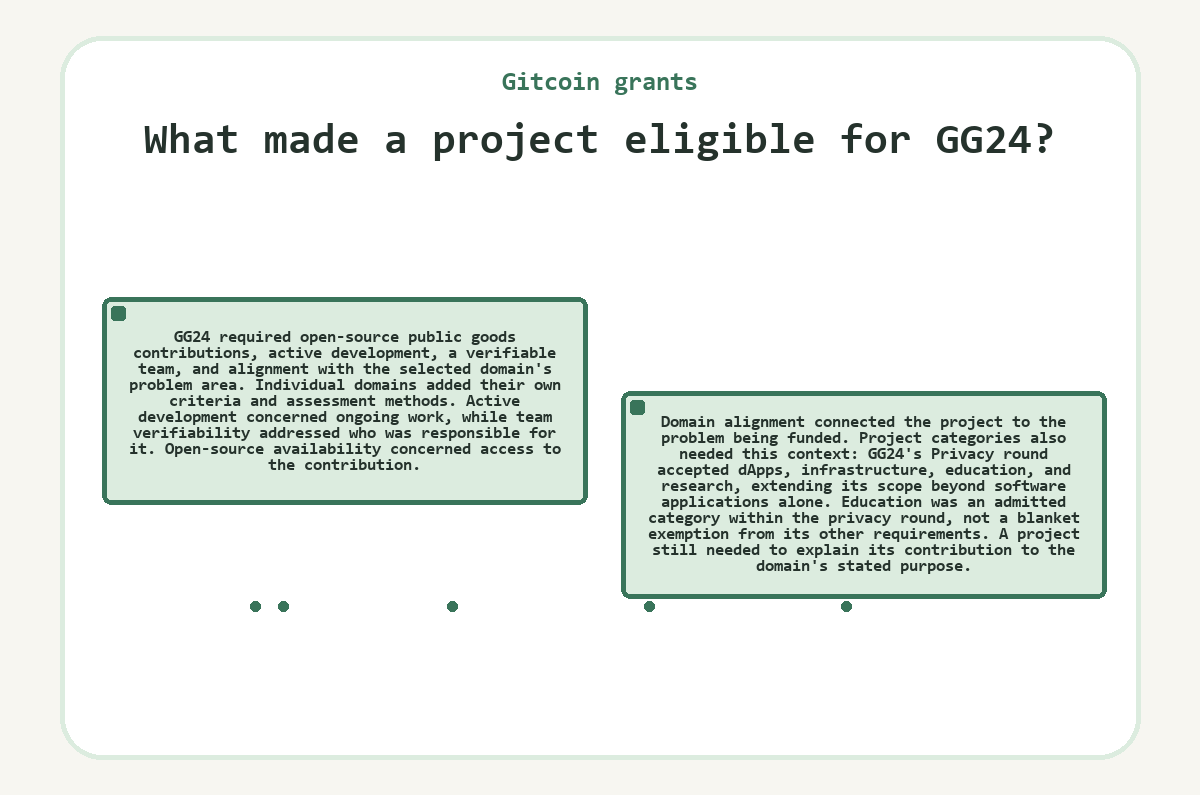
GG24 required open-source public goods contributions, active development, a verifiable team, and alignment with the selected domain's problem area. Individual domains added their own criteria and assessment methods.
Active development concerned ongoing work, while team verifiability addressed who was responsible for it. Open-source availability concerned access to the contribution. Domain alignment connected the project to the problem being funded. Project categories also needed this context: GG24's Privacy round accepted dApps, infrastructure, education, and research, extending its scope beyond software applications alone. Education was an admitted category within the privacy round, not a blanket exemption from its other requirements. A project still needed to explain its contribution to the domain's stated purpose.
Checking an application's fit before submission
An application can describe useful public goods work while leaving its fit with a particular round unclear. Before submission, compare the draft with that round's criteria. The application should make the relevant connection visible, without relying on a general claim the project benefits the ecosystem.
- Identify the selected domain and the problem the project addresses.
- Address the applicable baseline; GG24 required open-source public goods work, active development, and a verifiable team.
- Match supporting material to the round's assessment, such as repository evaluation or completed-work review.
- Distinguish the application deadline from the donation period and any later delivery phase.
- Check the award's milestone and reporting terms where the campaign requires them.
Recheck the revised draft against the same criteria. If a requirement remains unanswered, revise it again or consider a better-fitting round. The revised text should connect project evidence with each applicable requirement; admission remains the round operator's decision.
Allocation rules shape support after admission
Once a project qualifies for a round, the allocation mechanism determines how community support or project evaluation translates into funding. Eligibility identifies the participating set of projects.
QF rounds combine direct contributions with a share of a sponsor-funded matching pool. Donor participation influences matching, and round operators review contribution data for manipulation. Projects with broader legitimate support can attract more matching, subject to the applicable pool and round rules. The direct donations a project receives and its matching allocation remain separate amounts.
Other tracks assess different signals. Deep Funding's GG24 tooling assessment evaluated eligible repositories through prediction markets. Retroactive funding evaluates completed work, while GG24's Solutions Development program used milestone-based grants. Where an award depends on milestones, agreed deliverables remain relevant after selection. A project's admission alone does not resolve those later conditions.
Application acceptance, grant approval, and disbursement describe different stages. A funding record needs its stage and award conditions to explain what the project has actually received.
Grants Stack's retirement changed the application route
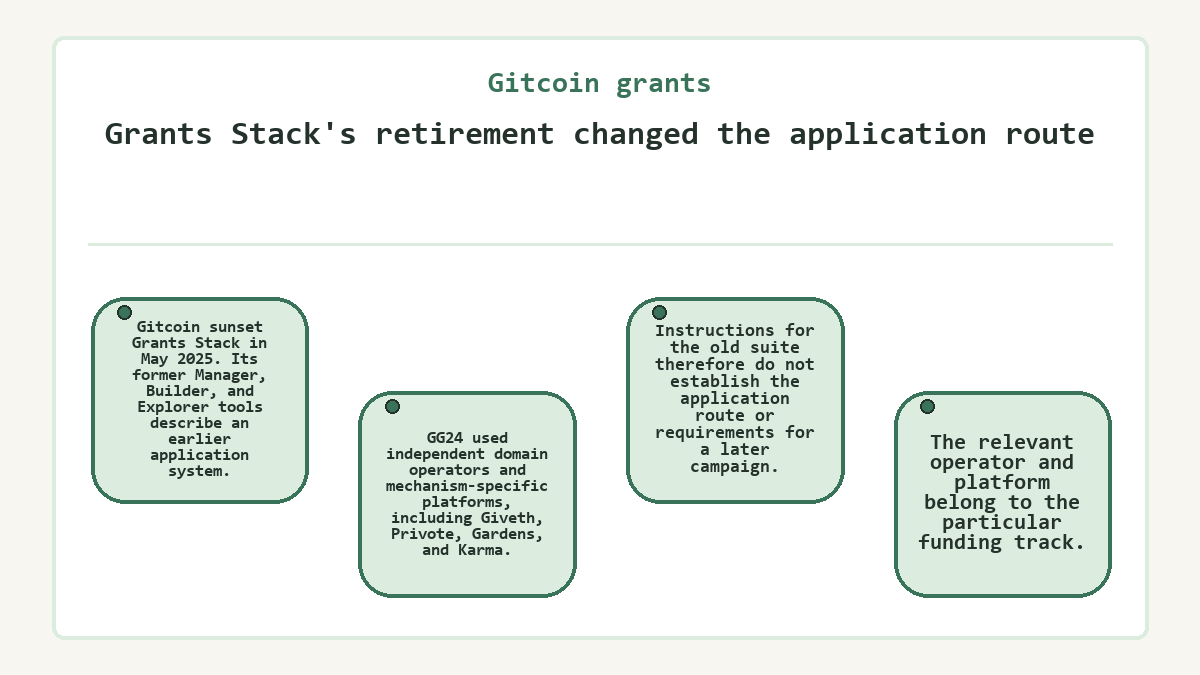
Gitcoin sunset Grants Stack in May 2025. Its former Manager, Builder, and Explorer tools describe an earlier application system. GG24 used independent domain operators and mechanism-specific platforms, including Giveth, Privote, Gardens, and Karma. Instructions for the old suite therefore do not establish the application route or requirements for a later campaign. The relevant operator and platform belong to the particular funding track.
Campaign calendars and proposed entry requirements
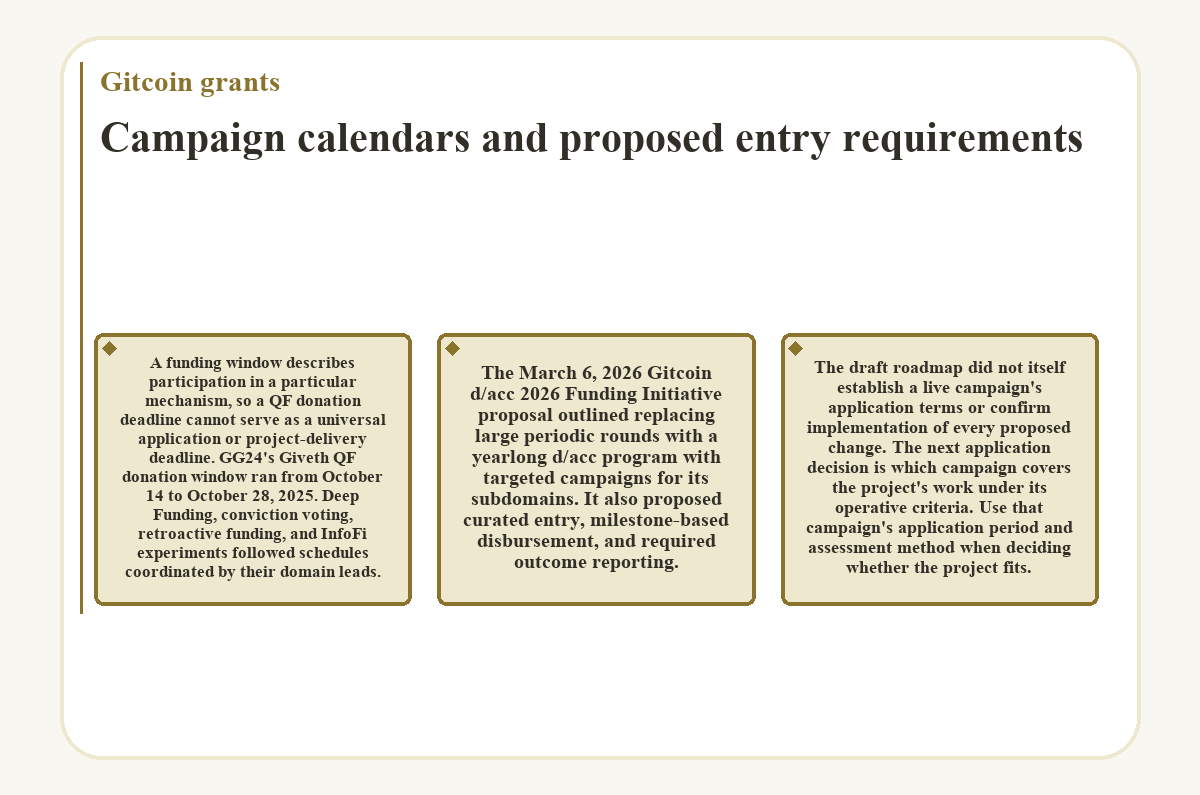
A funding window describes participation in a particular mechanism, so a QF donation deadline cannot serve as a universal application or project-delivery deadline. GG24's Giveth QF donation window ran from October 14 to October 28, 2025. Deep Funding, conviction voting, retroactive funding, and InfoFi experiments followed schedules coordinated by their domain leads.
The March 6, 2026 Gitcoin d/acc 2026 Funding Initiative proposal outlined replacing large periodic rounds with a yearlong d/acc program with targeted campaigns for its subdomains. It also proposed curated entry, milestone-based disbursement, and required outcome reporting. The draft roadmap did not itself establish a live campaign's application terms or confirm implementation of every proposed change.
The next application decision is which campaign covers the project's work under its operative criteria. Use that campaign's application period and assessment method when deciding whether the project fits.
Useful questions about Gitcoin grants
Does Passport verification replace a project's eligibility requirements?
Passport verification concerns the donor-side checks specified by a round; project eligibility concerns the work seeking funding. GG24's Giveth-operated QF rounds used donor verification, while applicants still faced public goods, active development, team, and domain-fit requirements. A verified donor identity did not establish a project's eligibility or entitlement to an award.
Which networks hosted GG24's Giveth QF rounds?
GG24's developer tooling QF round used Arbitrum, while its interop QF round used Celo. Both used Giveth, but they were separate round instances. Their shared platform and matching mechanism did not make their network configuration interchangeable. These choices describe those GG24 rounds and do not establish a universal network requirement for grant applicants.
How many repositories did GG24's Deep Funding tooling assessment cover?
The GG24 developer tooling assessment covered 98 eligible repositories. Its recorded activity comprised roughly 500 evaluations from 50 evaluators. Those figures describe that assessment cohort, not a standing intake cap or minimum activity threshold for later grants. Repository eligibility still belonged to the specific funding track.
Were GG24's Solutions Development grants all the same size?
GG24's Solutions Development program approved grants ranging from $2,500 to $20,000 per project. It approved 19 projects within a milestone-based funding structure. Those figures belong to that program and round; they do not establish a minimum, maximum, or standard award for other Gitcoin funding tracks. Approval also differs from completed disbursement.
How did MACI change voting in GG24's Privacy round?
MACI used encrypted voting to reduce opportunities for collusion in GG24's Privacy round. The round used Privote to apply Minimal Anti-Collusion Infrastructure. Private voting affected how participants expressed funding preferences, while project admission followed the round's eligibility rules. Ballot privacy did not remove the requirement for a verifiable project team.
Why can a provisional QF match change after a round?
QF matching can change after integrity reviews and adjustments for coordinated participation. Sybil activity involves misleading participation through multiple identities. Connection-Oriented Cluster Matching, or COCM, can reduce matching influence from coordinated donor clusters. A preliminary calculation therefore need not equal the allocation finalized after the round's reviews.