 Gitcoin
 uses an Octant v2 treasury pilot to fund grant matching from realized yield
Gitcoin designed its Octant v2 treasury pilot to fund grant matching from realized yield while retaining ownership of deposited principal. The underlying DeFi strategy produces the returns; the vault directs them to the matching pool. Governance controls allocation decisions, and principal preservation remains a pilot objective subject to smart contract and strategy risk.
Yield-powered matching adds a capital source alongside the donations and sponsorships used in grant funding. The treasury deposit, income available for matching, and a project's eventual award are different amounts, governed by different decisions.
Key takeaway: Gitcoin retains ownership of its deposited principal, while expansion of the yield-funded matching pilot requires separate governance approval.
Octant v2 connects treasury assets, yield strategies, and matching funds
The pilot connects treasury capital with grant funding through a vault and its underlying strategy. These components have different jobs: the treasury supplies assets, the strategy generates returns, and the allocation destination receives realized yield.
Treasury assets
The initial structure assigns a treasury commitment to Gitcoin and a separate commitment to Octant. Each organization supplies principal through its own vault. Deposited capital supports the strategy, while the grant matching pool receives the resulting yield.
Yield strategies
Octant v2 provides vault infrastructure built on ERC-4626 and Yearn v3 architecture. The selected DeFi strategy supplies the economic return. A vault can provide accounting and routing without guaranteeing the strategy's performance. Strategy selection therefore affects both the funding stream and the treasury's exposure.
Matching funds
The configured allocation address receives the realized yield designated for matching. Governance then controls how matching capital supports campaigns. Routing money to this destination establishes a funding stream; individual grants still depend on allocation decisions and campaign rules.
Realized yield determines what reaches the matching pool
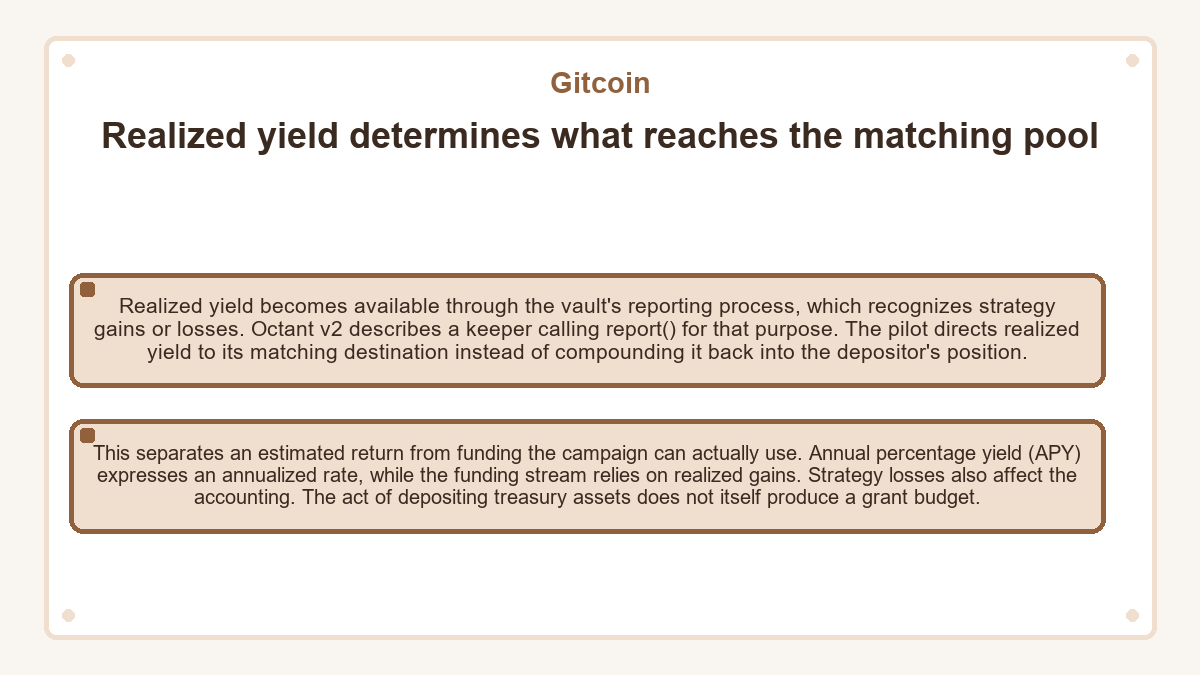
Realized yield becomes available through the vault's reporting process, which recognizes strategy gains or losses. Octant v2 describes a keeper calling
report()
for that purpose. The pilot directs realized yield to its matching destination instead of compounding it back into the depositor's position.
This separates an estimated return from funding the campaign can actually use. Annual percentage yield (APY) expresses an annualized rate, while the funding stream relies on realized gains. Strategy losses also affect the accounting. The act of depositing treasury assets does not itself produce a grant budget.
Separate vaults supply a shared matching destination
On May 7, 2026, Gitcoin reported implementing its treasury deployment proposal through an Octant v2 vault. The announced initial structure paired $1 million from Gitcoin with a $1 million Octant match, bringing the combined capital in that design to $2 million. Octant's matching commitment uses its own vault, with yield directed to the same allocation address. The proposal put Octant's total matching commitment at up to $2 million.
The paired capital describes assets supporting the strategies. It does not describe an award budget or mean the same amount went to projects. The announcement establishes a reported deployment milestone; harvesting, allocation, and project payments remain distinct outcomes of the funding arrangement.
The reported USDC deployment differed from the USDS option
The proposal allowed either USDC or USDS, while the May 2026 implementation announcement described USDC deployed through a Steakhouse USDC strategy on Morpho.
The proposal's USDS branch
The USDS option referred to Sky's Savings Rate and the SkyCompounder strategy. In that branch, the strategy would deposit USDS into Sky's savings contracts. This identifies a particular yield source; it does not describe the reported USDC strategy or establish simultaneous use of both assets.
The reported USDC strategy
The May announcement identified the USDC deployment and its Morpho strategy. Gitcoin selects its strategy according to its risk tolerance; Octant provides the vault infrastructure and yield routing.
How much yield can the treasury pilot provide?
The funding amount changes with deployed capital, realized strategy performance, and the period over which returns accumulate. The pilot does not establish a fixed quarterly grant payment. An annualized rate alone cannot establish how much matching capital a particular campaign will receive.
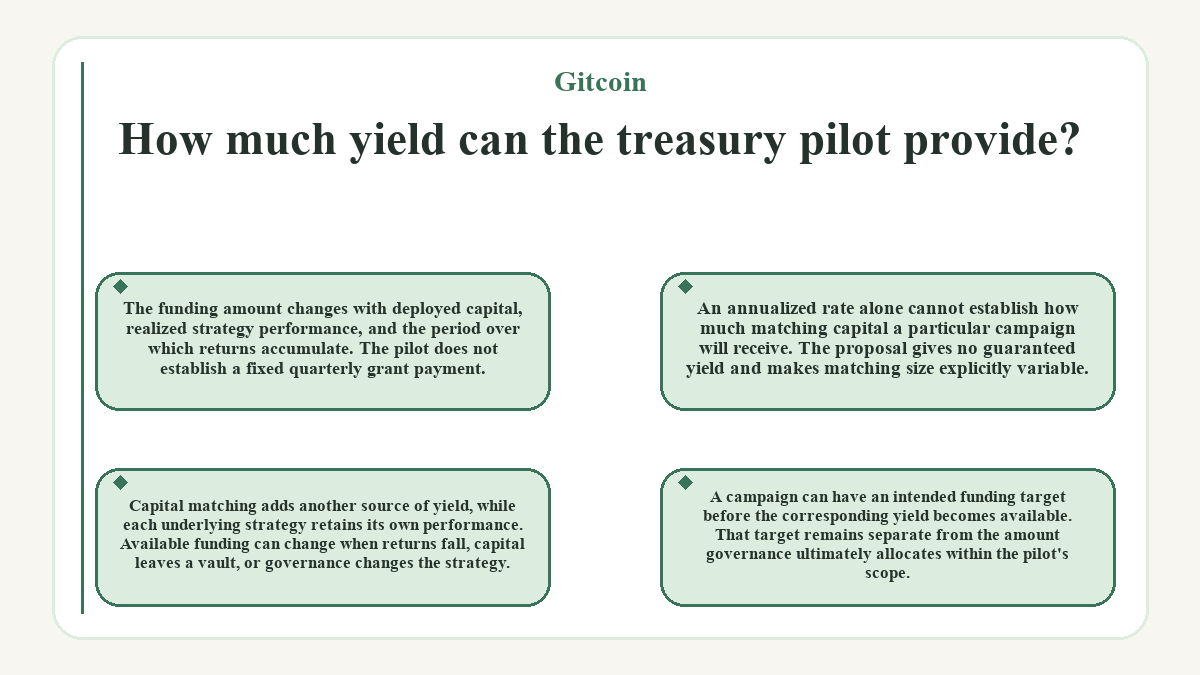
The proposal gives no guaranteed yield and makes matching size explicitly variable.
Capital matching adds another source of yield, while each underlying strategy retains its own performance. Available funding can change when returns fall, capital leaves a vault, or governance changes the strategy. A campaign can have an intended funding target before the corresponding yield becomes available. That target remains separate from the amount governance ultimately allocates within the pilot's scope.
Principal preservation remains a pilot objective
The pilot aims to preserve principal while using yield for public goods funding. Its risk provisions still identify possible capital loss. Non-custodial ownership concerns control of the assets; it does not remove the economic exposure created when a strategy deploys them.
Strategy losses and the yield buffer
The proposed architecture uses unharvested yield to absorb strategy losses before principal. That buffer provides a specific protective mechanism, with protection limited by the yield available to absorb losses. Preserving the deposit remains a success criterion, rather than a guaranteed outcome.
Smart contract exposure
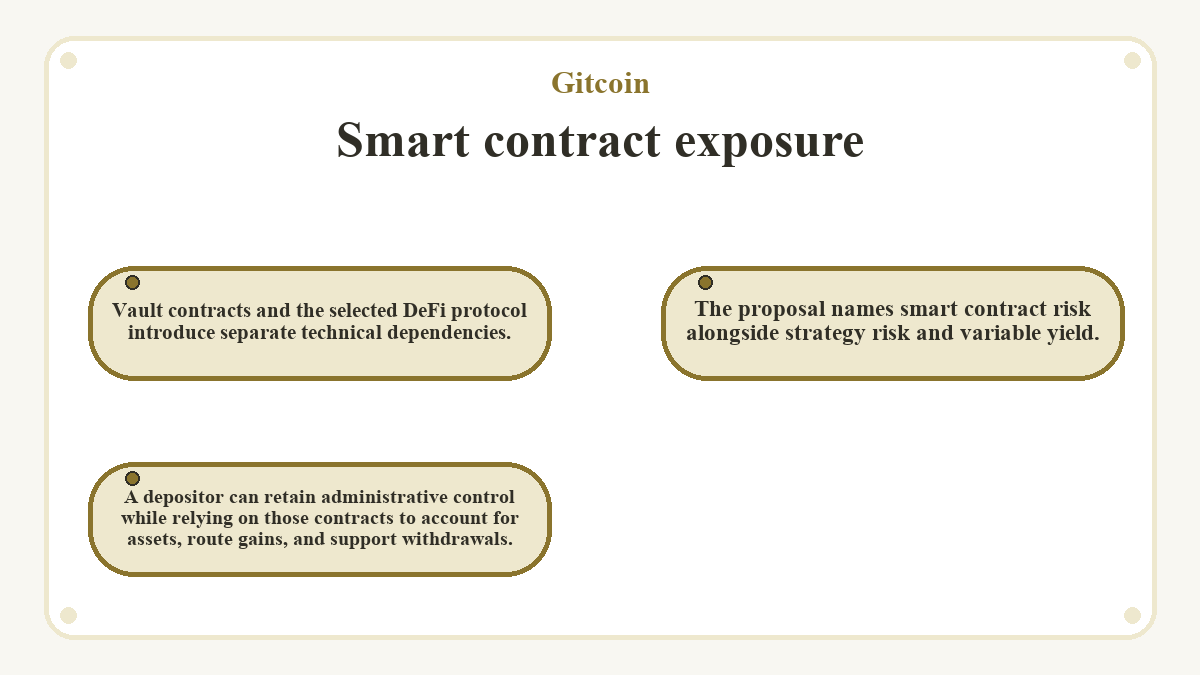
Vault contracts and the selected DeFi protocol introduce separate technical dependencies. The proposal names smart contract risk alongside strategy risk and variable yield. A depositor can retain administrative control while relying on those contracts to account for assets, route gains, and support withdrawals.
Can Gitcoin withdraw its principal during the pilot?
The pilot terms give Gitcoin withdrawal rights without a timelock. They also preserve its control over strategy selection. These rights let governance manage the treasury commitment during the experiment, while the risk provisions continue to apply to deployed capital.
The proposal called for considering an additional tranche after four to six months. It does not create a mandatory holding period for the initial deposit. Withdrawal rights and capital preservation also address different questions: governance controls the position, while the strategy's performance affects its value. The pilot explicitly lists loss of principal among its failure signals.
Governance controls allocation while operators manage the vault
Gitcoin governance retains final authority over allocation decisions, while Octant supplies infrastructure and helps design the campaign using the yield. Co-design and capital matching therefore do not transfer final spending authority to the infrastructure provider. Gitcoin governance also determines the final round structure.
Octant v2 distinguishes management, keeper, and emergency administration roles within its vault infrastructure, alongside withdrawal and emergency controls. These roles concern running and controlling the vault, separate from decisions about which public goods receive funding. Governance assesses whether these activities justify the ongoing strategy exposure and operating effort.
The d/acc redesign was a separate governance proposal
The March 6, 2026 d/acc funding initiative draft proposed reorganizing the grants program around a yearlong domain focus. Its suggested campaigns included curated entry, milestone-based disbursement, and required outcome reporting. These were program-design proposals, distinct from the treasury pilot's yield-routing mechanism.
The draft contemplated yield and coalitional funding as capital sources. An author clarification on March 17 described the campaign map as a placeholder, with confirmed numbers awaiting later ratification.
The May treasury announcement reported a specific implementation; it did not announce adoption of the separate d/acc draft.
Treasury yield supplies capital while quadratic funding allocates it
Treasury yield answers where matching capital comes from, while quadratic funding answers how a matching pool is divided among eligible projects. A treasury-funded pool can support a funding mechanism without determining its allocation formula. Donor participation and round-specific conditions still govern the campaign's matching process.
Octant matches the treasury commitment with capital in another vault. Project-level matching supplements community donations through the selected allocation mechanism. A larger treasury contribution does not establish a fixed multiplier for an individual donor's contribution. Other allocation approaches, including retroactive funding, address different campaign decisions. Final round design remains with governance, so the treasury pilot does not establish a universal eligibility policy or a single allocation method for every campaign.
Conditions for repeating or expanding the pilot
A decision to repeat or expand the pilot requires more than a completed treasury deployment. The proposal connects continuation with principal preservation, usable yield, and functioning operations.
- Principal remains preserved, with no loss recorded during the pilot.
- Harvested yield reaches matching and supports the intended funding use.
- Deployment, harvesting, and withdrawal operations function as expected.
- Generated yield justifies the operational overhead and complexity.
- Governance separately approves continuation, scaling, or yield reuse beyond the pilot.
The initial design contemplated considering a further tranche of up to $1 million from Gitcoin, matched by Octant, after four to six months. Continuation or expansion requires a separate governance discussion and approval.
Details worth knowing about Gitcoin
Does holding GTC create a right to the treasury pilot's yield?
Holding GTC does not create a claim on the yield designated for this pilot's grant matching pool. The pilot proposal directs realized yield to matching and leaves allocation authority with governance. Token ownership does not change that configured destination or convert the treasury funding arrangement into a distribution of returns to holders.
Is a Spearbit audit equivalent to insurance for the treasury deposit?
The Spearbit audit is a security review of the vault framework, not insurance for the deposited assets. The pilot separately identifies smart contract risk, strategy losses, and variable yield. Review of the framework does not establish a guarantee for the selected strategy or remove principal preservation from the pilot's success criteria.
Was the pilot intended to fund GG25 payouts?
The January 2026 discussion moved the intended use of initial harvests from GG25 toward GG26. That planning target depended on when capital was deployed and how much was committed. It did not establish a guaranteed payment date, and the May implementation announcement should not be read as confirmation that a named round received its payout.
How does Octant's capital match affect the APY on Gitcoin's deposit?
The capital match adds a separate yield-producing deposit; it does not itself change the annual percentage yield on Gitcoin's deposit. Both vaults direct their designated yield to the same funding destination. The combined arrangement can supply more matching capital while the underlying strategies determine the returns on their respective assets.
Does using ERC-4626 establish eligibility for a grant funded by the pilot?
ERC-4626 describes the vault infrastructure and does not establish project eligibility for a funded campaign. The treasury pilot supplies matching capital, while campaign criteria and allocation decisions determine which projects receive support. A project's application requirements therefore come from the relevant campaign, independently of the standard used for the treasury vault.